
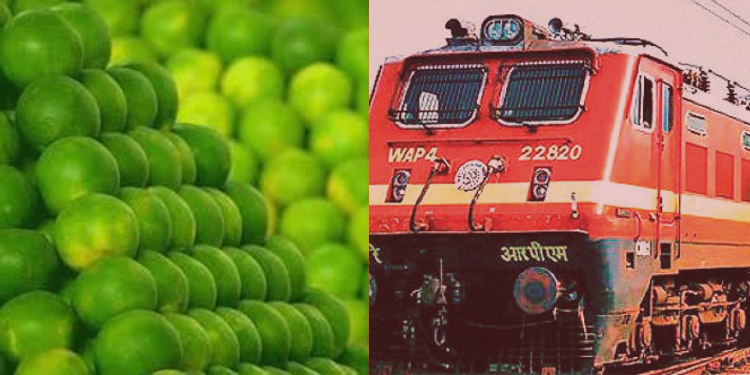
Anantapuram district has become a horticultural hub in the last few years due to its geography and climate, besides the relentless push by the previous Naidu government. Farmers too are cultivating quality horticulture crops, spending money wisely and putting in the hard work needed to reap a good harvest. Unfortunately, they are not getting returns worth their labour owing to lack of marketing facilities. To address this problem, train transport facility in the form of Kisan Rail service has been launched to carry fruits to Delhi markets. This is a boon for the farmers in the district, but Kisan Rail has as many demerits as merits.
Ending role of middlemen
The Kisan rail which was flagged off in Anantapur on September 9 is only the second such service in the country. Farmers can sell their products directly to traders in Delhi, thus eliminating the role of touts. Above all, their goods will reach Delhi in just 36 hours instead of taking weeks through road transport. On an experimental basis, 23 tons of fruits of five-six varieties were transported in 14 bogies of the train.
Increased costs
While there are certainly some benefits, there are also negative aspects for the initiative. It costs Rs. 1.10 lakh to Rs 1.5 lakh to send a lorry load of fruits to New Delhi. It costs almost the same for train as freight costs per ton are Rs 5,132, which comes to the same amount as in the case of lorry carrying 23 tonnes. The deal breaker here is the increased labour costs. In the case of lorry transport, the vehicle is directly loaded at agriculture field and unloaded at the destination market. The farmers have to spend on labour only two times, while loading at farm and unloading at market. But in the case of Kisan Rail, they have to bear extra labour expenses, i.e. from farm to railway station, where it has to be loaded once again on to the train. If the market is closed by the time the commodity reaches there, farmers have to shell out money for storage too. There are also apprehensions about the transport of produce from farmers of small holdings. Language is another barrier for our farmers in the national capital. Without a doubt, if everything works out as smoothly as expected and farmers receive better prices, it will benefit the horticulture farmers immensely.
Less enthusiasm
YSRCP leaders and government officials claim Chief Minister YS Jagan Mohan Reddy introduced the Kisan Rail to help the drought-hit farmers of Anantapuram. But it has to be seen how enthusiastic the farmers are on this initiative. Twenty bogies were arranged in the inaugural train, but only 14 bogies were loaded. That means only 325 tons of produce was transported as against the total capacity of 460 tonnes on the train. The government authorities are unable to decipher what farmers are thinking about the new mode of transport. It is important for them to educate farmers and help them make decisions that prove beneficial.