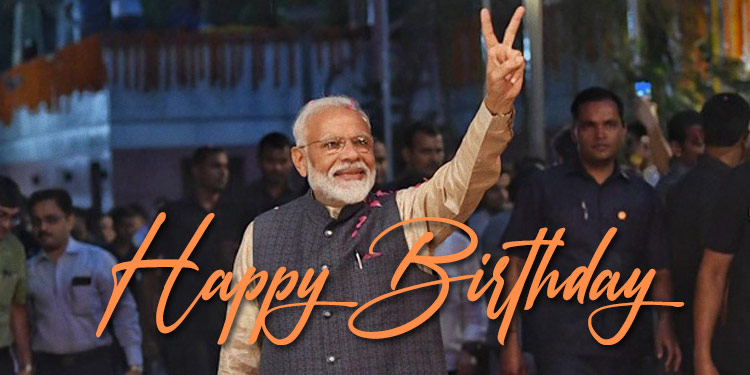
Narendra Damodar Das Modi. The name is synonymous with development, determination and stable leadership. He is also a controversial person, and a bundle of contradictions. Born in a backward caste in a remote village, his leading the world’s biggest democracy itself is a lesson in personality development. A panoramic view of the leader who is celebrating his 70th birthday today…
May 16, 2014 is an historic day that marked the victory of a tea vendor against the Congress, the Grand Old Party of Indian politics. That is the day that proved the greatness of Indian democracy where even a man of humble origins can become a prime minister. But behind that victory of Modi, there was suffering, agony, tears, humiliations and rejections. Undaunted by them, he pressed on to helm the nation of 1.3 billion.
Narenrdra Modi was born on September 17, 1950 in a poor family at Vadnagar in Mehsana district in Gujarat (then part of Mumbai province). He is the third child of Moolchand Modi and Heera Ben. He used to help his father in selling tea in Vadnagar railway station from childhood. Later, he also ran a tea stall along with his brother. He was attracted to RSS ideology at the age of 8 years. He would attend training programmes of the Sangh. He met his political mentor Lakshmanarao Inamdar during Sangh activities. He also came into contact with Nathalal Jagda, Vasant and others who laid foundations for BJP in Gujarat in early 1980s. He was married to Yashoda Ben of his caste at a very young age, but he did not live with her as he dedicated his time and life to the RSS. No one knows his marital status until he revealed that he has a wife right before the 2014 elections.
Indira Gandhi imposed Emergency on June 25. The 21-month dark period in Indian democracy provided a great opportunity for Modi to grow politically. Amid arrests and incarceration of opposition leaders by the Indira government, Modi was appointed as general secretary of Gujarat Lok Sangraha Samiti. He participated in many agitations against the Emergency. He toured across the state in disguise, distributing pamphlets against Emergency. He also wrote ‘Sangharsh Ma’ book during this period. After the Emergency, he went to Delhi. He later returned to Gujarat and worked in RSS. Party central leadership recognized his role in the victory of the party in 1987 municipal elections in Ahmedabad and made him executive secretary of the Gujarat BJP.
Narendra Modi was sworn in as chief minister of Gujarat on October 7, 2001. The party high command had picked him following a slew of allegations of corruption and incompetence during Bhuj earthquake against the incumbent Keshubhai Patel. As chief minister, he was tasked with getting the party elected in 2002 Assembly polls.
On February 27, 2002, a bogie carrying Kar Sevaks from Ayodhya, was burnt at Godhra station in Gujarat, killing around 60 Sadhus. BJP alleged local Muslims had burnt the bogie, in protest over the Babri row. VHP called for a state-wide bandh the next day in protest against the burning alive of Kar Sevaks. The riots that took place on the day of bandh and the next few days witnessed widespread murder and mayhem against Muslims. The state government announced that 790 Muslims and 254 Hindus died in the violence. But unofficial estimates put the death toll at more than 2,000. Around 1.50 lakh people were rendered homeless. DMK, TDP and other parties who were partners in the ruling NDA at the Centre called upon the BJP to replace Modi, holding him responsible for massacre of Muslims during riots, but the BJP top brass stood by him. In accordance with the wishes of the party, he won the 2002 Assembly elections with a huge majority. Since then, he continued to rule the state till 2014. He turned Gujarat into a model for industrial development and efficient administration to the entire country.
Fed up with a series of scams during the 10 years of UPA rule, voters elected Modi as prime minister in May 2014. People expected development and a clean government. But since coming to power, Modi is accused of laying more emphasis on RSS tenets of ‘Hindi, Hindu and Hindustan’ than on jobs and development. He made his long-time colleague Amit Shah second-in-command. Under his rule, BJP spread to new states and sections of population. Some of his decisions have had a serious impact on the economy and lives of people. Note ban wreaked havoc on the economy and livelihoods of poor and middle classes. Its ripple effects are still being felt. Many accuse him of turning the state into Hindu Rashtra, much against the spirit of secularism enshrined in the Constitution. He was elected for the second time in 2019 as there were no allegations of corruption against the government, absence of any major terrorist incidents and improved image of India on the world stage.
Religious division
While some parties derived electoral mileage on caste lines, the Modi-Shah duo used religion as a means to achieve political power. The BJP which dwelt non-stop on black money stashed abroad became silent after coming to power. The Modi-Shah changed tack in the 2019 elections by pushing nationalist agenda, instead of economic achievements. Inexperience and incompetence of Rahul Gandhi and the well-oiled machine of BJP and RSS saw to it that Modi romped home with an unprecedented majority. He has mastered the art of making use of even criticism by his rivals as he did in case of ‘chaiwallah’ jab of Digvijay Singh.
Undoubtedly, Modi is the strongest leader since Indira Gandhi in independent India. He is credited with clinching the centuries old dispute over Ayodhya. He displayed his political courage by scrapping Article 370 in Jammu and Kashmir. The entire nation obeyed his word without a murmur on lockdown at the start of Covid crisis, though its effectiveness and the sudden manner it was announced are debatable. Let us hope that Modi will take India to new heights by making use of his charisma and trust of people.