The current situation in the country makes us question the essence of Independence. One lean and simple man fought stubbornly, and stood up against an invincible empire. Today, the poor are becoming poorer and the rich are getting richer. It appears that the midnight, when we attained independence, was stillborn, and the dawn is yet to break.
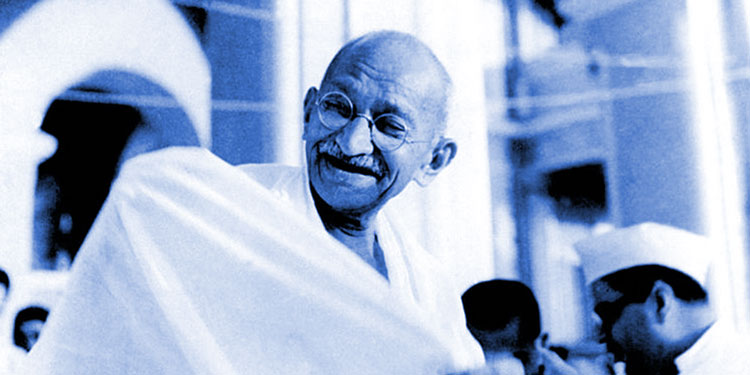
An emaciated but determined man walking with the support of a stick created history, changed the fate and course of the nation. There were several powerful and emotional incidents that resolved him to fight white supremacy and discrimination using non-violence as a weapon. His train journey from Durban to Pretoria in South Africa on June 7, 1893, can be considered the turning point of his life. Sitting in the station alone, shivering in the freezing cold, many conflicts enveloped his mind, and a new, resolute man took shape.
On that silent night, Gandhi was travelling first class in a train that reached Maritzburg at 9 pm. A white passenger entered the compartment. He looked at him contemptuously before disembarking the train. He came back with two officials. One of them approached Gandhi and informed him that he should not travel in that compartment. Gandhi resisted because he was carrying a first class ticket. Taking outrage, the white men forced him out of the train, reason being Gandhi was a coloured man.
Winters are freezing in Maritzburg because of its high altitude and mountainous geography. Fearing another insult, Gandhi did not try to get his overcoat that was in another compartment. He sat in the station room silently, pondering deeply. For a moment, he thought of returning to India. He was not furious at the white officer who threw him out of the train. It may be an individual who did this, but it was the system which humiliated him by institutionalizing racism and discrimination.
In any system, individuals only reflect its shortcomings and ills. Gandhi would not have been subjected to such an insult if there was no system of apartheid. Instead of individuals, it should be the system that needs to be changed. Gandhi looked at it as a social evil. Accordingly, he explored ways to fight and erase it. It sowed the seed for a revolution.
Gandhi described this incident as a life-changing experience. Idea of non-violence and peaceful resistance which sprouted in his mind at that moment became a weapon for our nation, turning him into a Mahatma.
Unflinching leader
In his campaign for Independence, Gandhi never changed his stand under any circumstances. Whoever opposed his proposals or decisions, he would not budge. He has as many critics as admirers. There were many who used to dismiss or deride his concept of non-violence, but he took all these criticisms positively. Gandhi decided to go it alone if necessary as he believed in the strength of his ideology and what he believed in. Finally, he was proved right. His fight yielded expected results. He achieved his goal of obtaining Independence for India. But where are the fruits of his long and arduous journey? His uncompromising fight?
Shaming the Independence
Though we have achieved freedom, we are still in the shackles of social evils. Economic development has proved a mirage even after seven decades of independence. Politics has become a perverse game. Vote bank politics is ruling the roost.
Gap between the rich and poor is widening day after day. Caste discrimination is rampant. In fact, the humiliation meted out to Gandhi in South Africa is miniscule when compared with the discrimination and repression that is going on in the country. Caste bias, banishments, boycotts, two glasses system are still continuing.
Where is the security for common man?
Poor and middle classes are struggling to survive. Governments are not able to control prices of even basic essentials like vegetables. The welfare schemes proudly announced by the governments are just bribes for votes. They don’t usher in any significant change in the economic and social status of large sections of people. Middle class is facing a severe crisis.
If we take the latest Covid-19 crisis, the media is replete with horrible stories of villagers refusing to even allow cremation of bodies of infected persons. Covid patients have the option of either disposing of whatever assets they have to avail medical treatment or put themselves at the mercy of Almighty. The only beneficiaries of this crisis are private hospitals. Governments remainsilent spectators, confining themselves to just warnings. Scenes of migrants walking thousands of miles to their homes during lockdown moved people not only in India, but across the world.
Humanitarians like actor Sonu Sood came forward to help these hapless people, which in a way exposed the inability and inaction of the governments.
A blot on the conscience
It is said we will attain true independence when a woman can reach home alone at night. By that parameter, we have not achieved true independence. Not a single day passes without reports of rapes and atrocities on women. The incident of brutal rape of Nirbhaya in December 2012 made us hang our heads in shame. To soothe the mood of the people, the Centre enacted a tougher law to punish rapists, but it proved ineffective, going by the unabated crimes. In the latest incident, a 19-year-old girl was gang-raped and brutalised by four men in Uttar Pradesh. After 15 days of agony, the girl succumbed at a Delhi hospital, triggering outrage across the nation.
Two days before this girl’s death, some miscreants killed a 14-year-old girl by hanging her from a tree in UP. In September alone, the state witnessed four rapes in Akhimpur. Honour killings are becoming common. Parents themselves are killing their children if they marry persons outside their caste or below their financial stature. We are witnessing several such incidents in our Telugu states as well. What sort of progress and development do such incidents signify? What a pity that we have to see people who do not take law of the land seriously and behave in an inhuman manner! This is a time for serious introspection about the meaning of Independence, especially when the country is facing a multi-pronged attack in the form of poverty, unemployment and backwardness.